
A brief Coffee Table Chat | BETWEEN THE SEEN AND THE FELT
One-on-One with Jesús Parrilla
What if hospitality wasn’t something you built, but something you uncovered? In this intimate Coffee Table, Jesús Parrilla— co-founder of Experiential Hospitality—invites us into the quiet beginnings of a bold vision. From the silence of the Aconcagua Valley to the rhythms of trails and shared meals, this conversation explores the deeper why behind a company that dissolves the boundaries between architecture and land, guest and guide, comfort and courage. As the industry rushes to define “experiential,” Parrilla slows down to ask: What lingers after the journey ends?
- What was the moment—or series of moments—that made you realize you had to create Experiential Hospitality?
In all honesty, it’s never been a single moment. It’s been a quiet accumulation: early involvement in a nascent industry, travel to remote places, long hikes that became meditations, and the silence of landscapes that asked for nothing yet gave everything.
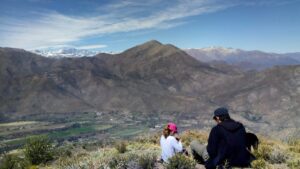
But if I had to name a place, I’d say it began in the Aconcagua Valley, in a mountain cabin I built in Chile. I was hiking and biking in the Andes almost every weekend; sometimes alone, sometimes with family. Something in me began to shift, not toward building something new but toward revealing something that already existed.
This isn’t my first attempt. It’s my third. So, I have come to understand the difference between momentum and meaning. This time, I wasn’t chasing a model. I was answering a calling.
2. What personal values did you refuse to compromise on when founding the company?
We lead, we don’t follow. That principle guides everything. We didn’t build Experiential Hospitality to mimic what others were doing. We built it because I believe the industry needed a deeper why. We put our people first because if the team is nourished, the guest will be too. Safety isn’t negotiable. Adventure can only be transformative if it’s rooted in care and a deep understanding of the nuances of being outdoors. We let architecture emerge from the land, not impose itself onto it.
And we don’t speak about sustainability as a feature—it’s the foundation: from how we source food to how we treat water, to how we show up as neighbors. But perhaps the most sacred value is humility. When we enter a place, we do so as listeners first. The land has its own story. Our role is not to overwrite it, but to learn how to belong within it.
3. Was there a gap in the hospitality industry that frustrated you enough to want to fill it? What was missing?
I wouldn’t call it frustration. It was more like a quiet observation that kept returning. The gap I saw was subtle but profound: a disconnect between what happens within the hotel and what happens beyond it.
Many brands have mastered the indoors. But when the guest steps outside, the spell breaks. The experience becomes fragmented, outsourced, transactional, and often underwhelming. I wanted to build a hospitality company where there is no line between inside and out—where what you feel in the lobby flows seamlessly into what you feel on the trail, at the table, or around a fire.
Too often, we obsess over the tangible: thread counts, square footage, wine lists. But the soul of travel lives in the intangible—the sense of awe, of enlightenment, of grounding, of discovery. That’s the space we aim to hold.
4. How do you define “experiential” in a world where that word is now everywhere?
For us, “experiential” isn’t a buzzword. It’s a responsibility. It means unlocking what’s felt but not always seen—the wind patterns of a valley, the ritual behind a local dish, the pace of life in a place that’s never rushed to meet the world.
Being experiential means designing with the senses and the spirit in mind. It means curating not just activities, but alignments—between people and place, between past and present.
In a world rushing toward the next “experience,” we ask: What are you remembering? What are you taking home? What are you reconnecting with? If the answer echoes beyond the itinerary, then we’ve done our work.