
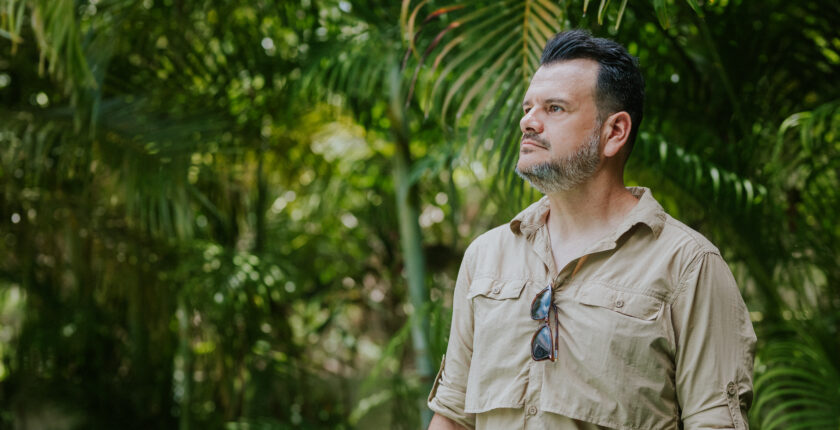
A brief Coffee Table Chat | What If Luxury Could Feel Again?
One-on-One with Javier Rojas
Fresh from the Hotel & Resort Design South (HRDS) event in Miami—where he served on the Advisory Board—architect and Chief Creative Officer Javier Rojas-Rodriguez returns not just with insights, but with questions that linger.
- What if luxury wasn’t about polish, but presence?
- What if design wasn’t a statement, but a conversation?
In this reflection, Javier challenges the industry’s obsession with function, asking us to make room for emotion, memory, and meaning. Through the lens of Experiential Hospitality, he calls for a return to what’s deeply human—and a future of design that doesn’t just impress, but resonates.

- You’ve attended many conferences over the years, but this time you stood there representing, for the first time, Experiential Hospitality, a company built not just around design, but around emotion, movement, and exploration. How did that shift in lens affect the way you heard the conversations around you?
It was a somewhat different experience this time. This time it wasn’t just about representing a company but about embodying a point of view, and a manifesto.
In the past, I’d attend conferences thinking about space, guest experiences, construction, or strategy. This time, I was listening for emotion. For how people spoke (or didn’t) about memory, about sensory experience, about the stories behind the spaces. The conversations around me suddenly had more layers. A discussion about materials became a conversation about texture, touch, and childhood memories.
A panel on guest engagement became a contemplation on anticipation and surprise. It made me realize that so many in our industry are craving deeper connections—but the industry itself is still using the language of function. With Experiential Hospitality, we’re trying to shift that language. It’s not just about how things are done, but about why and how they’re felt. And standing in that lens, I could feel the difference.
2. Coming from a career where placemaking often began with vision boards and materials, what does it feel like now to represent an analog brand where the place often comes first – and the design must listen before it speaks?

It feels like a return to something deeply human. In my previous work, placemaking often began in abstraction—mood boards, materials, aspirations projected onto blank space. Now, I’m learning to approach design more like a conversation than a proclamation. The land, the community, the spirit of the place—they speak first. My role is to listen carefully, to notice what’s already there, and to shape design that feels inevitable rather than imposed. It’s less about storytelling and more about story finding. There’s a humility to it, and also a kind of liberation: the place leads, and we follow.
3. After sitting in rooms filled with conversations about scale, luxury, and innovation, what conversations do you think are still missing, or not being asked loudly enough?
I think the conversations that are still missing—or not being asked loudly enough—are the ones about meaning. What does it mean to build at scale, or to create luxury, in a world where cultural and ecological fragility are escalating? We rarely interrogate the emotional, social, and environmental cost of our ambition. There needs to be more space for asking: Who is being left out of the narrative of innovation? What does luxury look like when it’s rooted in empathy, not just exclusivity? How do we measure success beyond aesthetics or ROI? The conversations that are missing are the quieter ones—about dignity, memory, cultural continuity, and restraint. And maybe those aren’t just missing—they’re intentionally avoided. So, I’d say: let’s make room for those.
 4. What insights did you walk away with from these events – not just as a creative mind, but now as a brand guardian of something that challenges the norms of luxury hospitality?
What struck me most was how essential intention is—both in creation and in operations. As a creative, I’ve always looked for beauty, innovation, and emotion. But also, in the role of brand guardian, those elements must also align with a deeper purpose. These events confirmed for me that the future of luxury isn’t about excess or perfection—it’s about resonance, relevance, and responsibility.