
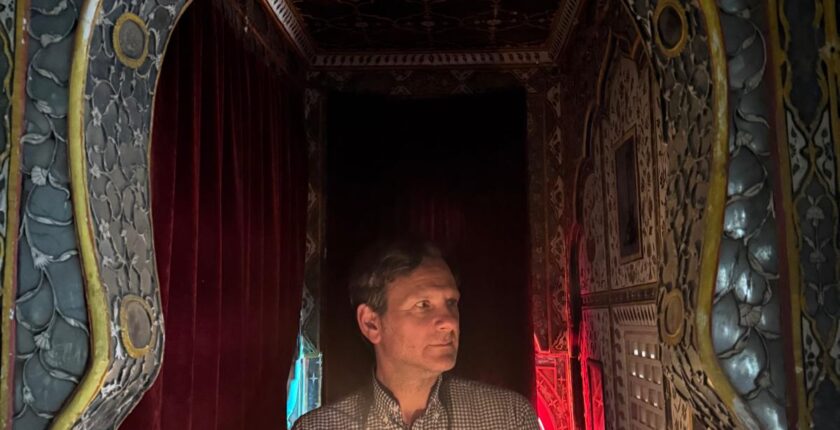
A Brief Coffee Table Chat | In Defense of Meaning
One-on-One with Jesús Parrilla
In a world where luxury is often reduced to polished surfaces and instant gratification, Jesús Parrilla reminds us that hospitality is not a checklist—it is a calling. As an expert who treats travel as a form of remembering rather than escaping, Parrilla invites us to rethink what it means to host, to journey, and to truly belong.
This conversation is not about design trends or brand campaigns. It’s about defending the invisible threads—the ones that connect place to memory, silence to story, host to land. Through quiet conviction and lived experience, Parrilla reveals why feeling, not function, should be the foundation of every guest experience. In this slow and thoughtful exchange, he speaks to the heart of what we do—and why we must continue to do it with care.
- You’ve regularly said that hospitality isn’t a product—it’s a worldview. How do you ensure that our spaces and services continue to stir something within, especially in an industry often driven by function over feeling
We design to provoke memory, not just movement. If a space does not stir something inside you, then it has no reason to exist. The danger in hospitality today is that it has become a checklist of comforts, where utility replaces emotion, where technology and convenience dull curiosity, and superficiality often overshadows depth.
For us, every scent, every silence, every surface must feel like it belongs to the story. Not ours alone, but the story of the place. We are not interested in creating what is trendy or cool. We are interested in creating what lingers. What is felt days, even months later, in quiet reflection. That requires discipline. That demands depth of perspective, not just designing.
2. In a world addicted to speed, what does it take to defend the idea that remoteness is sacred—and that the journey itself is part of the experience, not just a means to an end
It takes a great deal of conviction. And a willingness to be misunderstood. Remoteness is not a logistical challenge for us. It is a spiritual decision. It reminds the traveler that effort matters. That arrival should not be instant but earned.
When you strip away the shortcuts, something ancient reawakens in people. They walk slower. They observe more. They speak less. And in that slowness, they begin to belong.
We are not in the business of removing the distance. We are in the business of making the distance meaningful. When the path itself becomes the teacher, then the destination becomes sacred.
3. With so many brands chasing aesthetics or clever messaging, how do you protect the soul of our storytelling—ensuring that what we say is always rooted in what we live?”
The story is not the brochure. It is the way the place breathes. It is the way a local guide pronounces the name of a mountain. It is what is left unsaid in a welcome ritual. We protect our story by first making sure it is real. That it was not written at a desk but discovered on foot. Every message must come from something lived. If not, it is just decoration. We are not here to entertain.
We are here to remember and to pay homage to the land and the cultures that give the place its soul. And when storytelling becomes a tool for remembering, it stops being a strategy and becomes a form of care. That is the difference.
4. With so many brands chasing aesthetics or clever messaging, how do you protect the soul of our storytelling—ensuring that what we say is always rooted in what we live?”
Hosting has been reduced to service metrics. To algorithms and scripted greetings. But true hospitality cannot be automated. It is an ancient act of generosity. An offering of presence.
To host is to hold space for another human being. To make them feel seen without needing to speak. To share what is local not as a spectacle, but as a gesture. We train our teams to be guardians of this ritual, not performers of it.
And perhaps most importantly, we do not believe the host stands apart from the place. The host is the place. Their voice, their knowledge, their kindness carries the land’s memory forward. That is not transactional. That is sacred.