
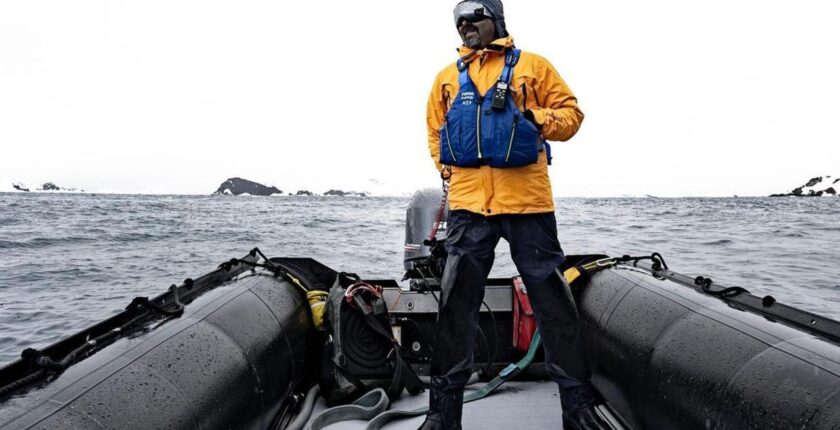
A Brief Coffee Table Chat |The Spirit of EXPLORATION One-on-One with Willie Parra For Willie Parra, travel has never been about ticking off destinations—it has always been about following curiosity wherever it leads. From his earliest days, inspired by Jacques Cousteau and driven by a fearless urge to dive into every lagoon and explore every creature, his journey has been shaped by wonder. Along the way, he has taken on countless roles—salesman, butcher, night watchman, cameraman, carpenter—each one adding a layer of grit and humility to his path. What ultimately defined his calling was the discovery that adventure could be both a career and a way of life. In this Coffee Table Chat, Willie reflects on the influences that sparked his love of exploration, the turning points that transformed his professional journey, and how his philosophy of traveling without expectation continues to shape the way he engages with the world. His story is a reminder that travel, at its best, is not about luxury or status but about openness, resilience, and the joy of discovery. 1. What was your biggest early influence that sparked your desire to travel? For as long as I can remember, I’ve been passionate about anything unusual… I was lucky to have a close-knit, active family who lived in the countryside and didn’t rely on the classic 8-to-6 office job. Although they were never very outdoorsy people, they were the “let’s go camping, but we’ll stay 50 meters from the car” type… In any case, they never conditioned my constant desire to dive into any lagoon I found or to touch any animal or creature that appeared. My obsession with not missing a single episode of “The Underwater World of Jacques Cousteau” lit that flame in my heart and mind: I had to do it, I had to see these places sooner or later. I’ve been lucky enough to have fulfilled most of those initial dreams… 2. What was the most important turning point in your professional travel career? I’ve done so many things in my life, career-wise. I come from a middle-class family, with an average income and no social connections to help me, so after graduating from high school, the idea of going to college to study Marine Biology was just a dream; there wasn’t enough money to pay for it, so I started working at 18 to be able to pay for it myself. I’ve worked as a clothing salesman, a butcher, a night watchman, a tour driver, an underwater cameraman, a carpenter, and more! But the moment everything changed was precisely when I went to college on my own and discovered a whole new world of activities. That’s when the company VERTICAL invited me to work with them as a Junior Mountain Guide. The rest of my story is something to sit down and talk about over a good wine… 3. How has your approach to travel evolved over the years? I’ve embraced every travel opportunity as a completely new path, without prejudice, without high expectations, just waiting for it to open up and surprise me—for better (ideally) or for worse. It doesn’t matter in the long run. Everything teaches you and prepares you for the next step. I approach it with humility, meaning I arrive receptive and energized. I’m eager to discover the essence of each location, its natural surroundings, and its people. I apply this approach both in urban areas, such as a new European country, and in more remote corners, such as Antarctica or the Arctic. I love traveling and exploring the unknown.
Coffee Table Chat with Julieta Chan | Between Structure & Soul
A Brief Coffee Table Chat |Between Structure & Soul One-on-One with Julieta Chan The hospitality industry is undergoing a profound transformation. Once defined by status and profitability, it now faces an ethical crossroads—where the question is not just how we build, but why we build, and for whom. In this Coffee Table Chat, Julieta Chan invites us into that reflection, sharing her journey of navigating complexity while holding onto purpose. Her perspective is rooted in both pragmatism and vision: the belief that structure—those often invisible systems that create coherence and trust—must coexist with soul, the values and intuition that give hospitality its deeper meaning. What emerges is a portrait of leadership grounded in listening, curiosity, and compassion. For Julieta, building a company is not about selling beds but about creating the conditions for transformative experiences—moments where travelers reconnect with nature, with culture, and with themselves. 1. How has your perception of the industry evolved since joining Experiential Hospitality? This is a personal perspective, shaped by my own experiences and interpretation of what’s happening in the industry, in the world, and in the communities we serve. I believe the industry is facing a moral and ethical crossroads. Profitability has become the dominant metric, accelerated by platforms like Airbnb that opened the sector to players without a tourism background. While this brought innovation, it also disrupted governance and reshaped the commercial landscape. The pace of change has been so rapid that governments and corporations are still struggling to respond—some are searching for solutions, while others remain passive or unaware. Since joining Experiential Hospitality, my perception has remained consistent: in times of chaos, it is essential to return to the core of why we exist. For me, that purpose has never been solely about profitability (though financial sustainability matters). It has always been about connecting people to nature, to different cultures, and to themselves through meaningful experiences—creating the possibility of a more tolerant and humane world through travel. Experiential Hospitality has become the strategy I discovered—or that discovered me—to fulfill that purpose. It offers the alignment, innovation, and sense of meaning that this industry urgently needs. 2. In building internal systems for a company that values emotion and intuition, how do you balance structure with soul? Building structure is not glamorous work—it’s heavy lifting. But it is essential. Structure creates coherence, alignment, and trust across every part of the company. When I design systems or documents, I try to approach them not as rigid rules, but as tools a mentor might use to teach or to create shared understanding—something that enables the team to move together with clarity. The “soul” of the system comes from the lens through which we create it. Every framework must be tested against our values, our philosophy, and our ethical compass. If a system doesn’t serve our purpose or align with our mission, then it needs to be revised and adapted. In this way, structure doesn’t constrain us—it becomes the backbone that gives life to our vision. 3. You’ve been one of the quiet architects of Experiential Hospitality’s growth. What has surprised you most about your own growth through this journey? Earlier in my career, I worked in hotels as a front-of-house manager, ensuring systems ran smoothly and that every guest’s experience was consistently exceptional. My focus was on delivering what was already designed. Now, my role is fundamentally different. I am helping to design the “behind-the-scenes formula” itself—everything from the architecture of a lodge, to the operational strategy, to the way the guest journey is imagined from the very beginning. It’s a rare privilege to sit at the intersection of design, operations, and finance—offering feedback to architects from an operational lens, while also learning how vision gets translated into a physical space, and then ensuring a strong commercial model backs it. 4. What have you learned about leadership from working across cultures, disciplines, and geographies at Experiential Hospitality? First and foremost, to listen deeply. To clear my mind, make quiet judgments, and be fully present with others. Listening in this way is not easy, but it is the key to truly understanding what matters. Second, to stay curious. Curiosity is the foundation of learning, and one of the greatest gifts I’ve cultivated here. It pushes me to ask questions, to uncover what lies beneath, and to keep expanding my understanding through others. Finally, to practice compassion—for myself and for others. Building a company from scratch is full of challenges. We don’t always get it right the first time—or the third. In the past, I judged myself harshly for that. Today, I see vulnerability as strength. Compassion allows me to ask for help when needed and to recognize that what we are building is bold and complex. We are not selling beds; we are selling transformative experiences. That is not an easy story to tell or a simple model to execute. Compassion helps me—and us—stay grounded in patience and persistence as we work to build the global community we envision.